Rajasthan has always known something the rest of India forgot. In the semi-arid heart of Mewar, where the soil is mineral-rich and the rains are scarce, wheat and rice were never the right fit. Bajra, Jowar, and Ragi were. These were the grains that fed desert warriors, kept farming families going through droughts, and nourished an entire civilisation for centuries — without a single drop of irrigation.
Then came “modern” food. Stone-ground Bajra got replaced by refined flour. Polished white rice pushed out Jowar. And a diet that had kept Mewar’s people strong for generations quietly vanished from the table.
Millets of Mewar opened on 2nd October 2011 to bring it back.
Ranked as the 6th healthiest restaurant in India by India Today and widely known as the best millet restaurant in Udaipur, this rooftop dining spot near Jagdish Mandir has spent 14 years proving one thing: ancient grains don’t need to be rescued. They just need to be respected.
The Problem With How We Eat Today — And Why Millets Fix It
In the last 50 years, Rajasthan’s traditional diet changed a lot. Stone-ground Bajra flour got replaced by refined wheat. Jowar rotis gave way to white bread. Ragi — one of the most calcium-rich foods on the planet — almost vanished from city plates entirely.
The result? Rising rates of diabetes, anaemia, gut problems, and gluten sensitivity in a population whose grandparents ate none of these staples.
The grains didn’t fail us. We abandoned them.
Why millets were always the right choice for this region
Mewar’s land — semi-arid, mineral-rich, low on rainfall — isn’t suited to wheat or rice. These are crops that need a lot of water, and this land simply doesn’t have it.
Millets are native to this soil. They grow on just 300–400mm of rain a year. No irrigation, no synthetic fertilisers, and they put nutrients back into the ground with every crop cycle. In the most basic sense, millets are the food this land was made to grow. Millets of Mewar was built on that truth.
The Millets of Mewar Story: Before It Was Trendy
In 2011, when Udaipur’s food scene was all about Continental breakfasts and greasy thalis, Millets of Mewar opened with a genuinely different idea: that Rajasthan’s so-called “poor man’s food” was actually the most nutritious thing anyone could eat.
Fourteen years later, the world caught up.
What changed — and what didn’t
Since 2023, when the United Nations declared the International Year of Millets, chefs, food scientists, and nutritionists across India have rushed to add millets to their menus.
Millets of Mewar didn’t rush. It was already here.
The ingredients, the sourcing, the locally farmed grains — none of that changed. What changed was that a sceptical world finally started listening to what this kitchen had been saying from day one.
What You Actually Eat Here
The menu at Millets of Mewar isn’t “health food” in the bland, boring sense. It’s real food — tasty, filling, and rooted in Mewar’s actual food culture.
Dishes worth knowing
- Bajra Pizza (Millet Grain Pizza) — A millet-base pizza that surprises almost everyone who orders it. Crisp, earthy, completely wheat-free, and genuinely satisfying. One of the most talked-about dishes on the menu.
- Millet Veg Biryani — Slow-cooked, aromatic, and built around millets instead of rice. The kind of dish that changes how you think about biryani.
- Multigrain Millet Thali — The full Mewar experience. A rotating selection of seasonal millet dishes, dals, and chutneys. Everything sourced locally, nothing processed.
- Millet Cookies & Desserts — Naturally sweetened, made with whole millet flour. A proper ending to a proper meal.
- What every dish has in common
Every item on the menu is:
- 100% vegetarian — no exceptions
- Vegan-friendly — fully plant-based
- Naturally gluten-free — no wheat in the kitchen
- Made with rain-fed, locally sourced millets from farms in the Aravalli region
This isn’t a marketing checklist. It’s the result of a sourcing philosophy that hasn’t changed since 2011.
Why These Three Millets Are Worth Knowing
The kitchen at Millets of Mewar runs on three grains — Bajra, Ragi, and Jowar. Each one brings something different to the table, in both flavour and nutrition.
Bajra (Pearl Millet): The iron-rich winter grain
Bajra is Mewar’s most iconic millet. It grows well in dry heat, needs almost no water, and has nearly double the iron of wheat. For centuries, Rajasthani homes made Bajra Raab — a warm, fermented porridge — as a winter staple. At Millets of Mewar, Bajra is the base of some of the most loved dishes on the menu: hearty, warming, and deeply nourishing.
Ragi (Finger Millet): The calcium powerhouse
Ragi is one of the most remarkable foods in the Indian diet — and one of the most ignored. It has more calcium per 100g than milk, making it the best plant-based source of bone nutrition for a vegetarian population. At Millets of Mewar, Ragi shows up in everything from rotis to desserts, with a slightly earthy, nutty flavour that’s completely its own.
Jowar (Sorghum): The gut-friendly all-rounder
Jowar is the gentlest millet — light in flavour, soft in texture, and very easy on the stomach. Its resistant starch feeds good gut bacteria and helps keep blood sugar steady, making it a natural pick for anyone managing diabetes or gluten sensitivity. The rotis are soft, the flavour is mild, and the health benefits are anything but.
Dining on the Rooftop Near Jagdish Temple
Food tastes different when the setting is right. And at Millets of Mewar, the setting is really good.
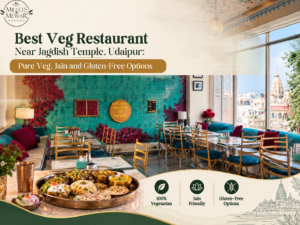
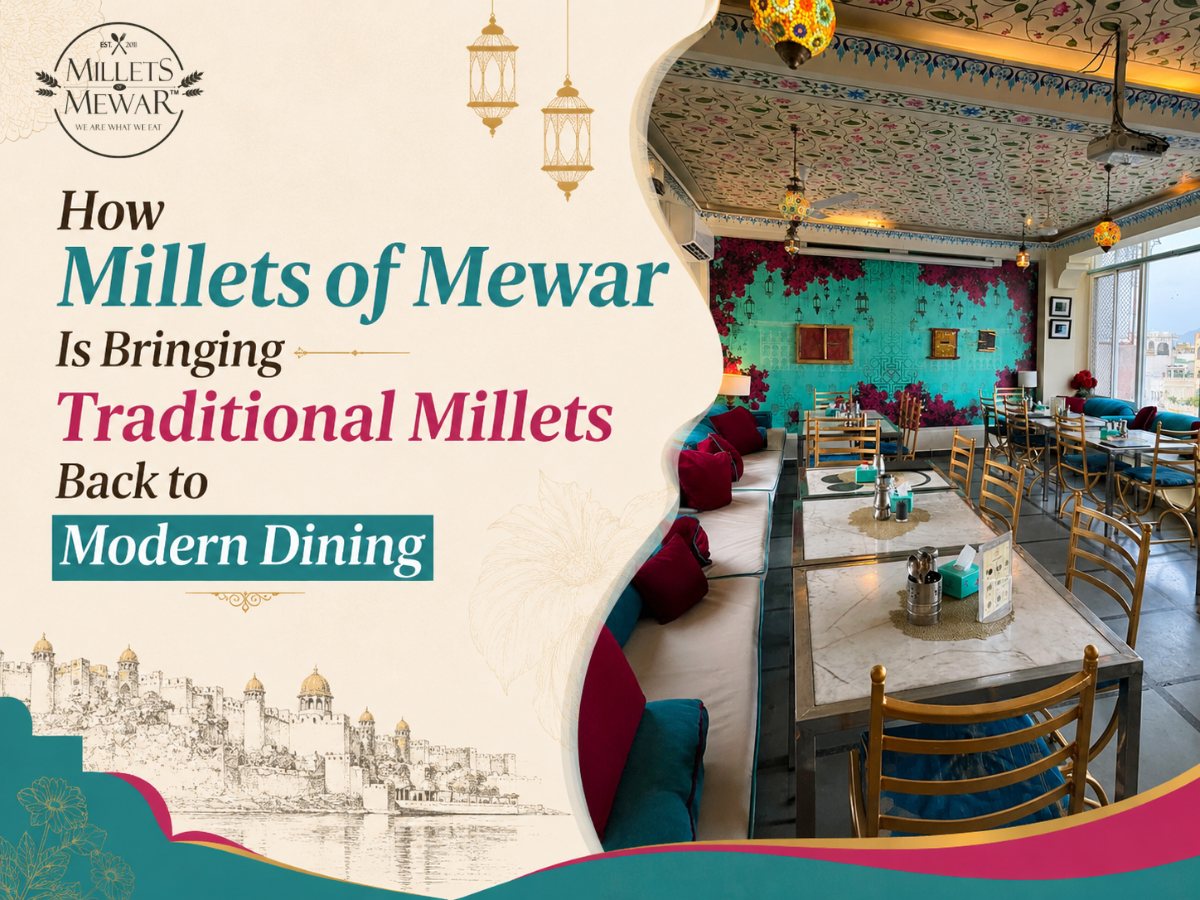
The rooftop dining space sits in the heart of Udaipur’s old city, near Jagdish Mandir — one of Rajasthan’s most respected temples. From the terrace, the old city spreads out below, Lake Pichola catches the evening light in the distance, and the sounds of the heritage quarter drift up through the open air.
What stands out most is how naturally the food and the setting go together. Eating Bajra roti in Mewar — surrounded by centuries-old stone architecture — is a different experience from eating it in a glass-fronted café. The grain on your plate grew in the same soil as the land around you. That connection is real, and it changes how the meal feels.
Guests come for the view. They come back for the food. Both are worth it.
Who Eats at Millets of Mewar
Over so many years, this rooftop has become a gathering spot for a wide and genuinely varied crowd:
- Travellers who’ve spent a week eating heavy curries and naans, and want something that actually feels good afterward
- Local families who grew up eating Bajra rotis in winter and want their kids to know that food
- People with gluten intolerance or wheat allergies who assumed eating out in Rajasthan would be tough
- Yoga and wellness retreat guests looking for sattvic, clean meals
- Nutritionists and food researchers who come specifically to study the menu
- Repeat visitors who found the restaurant on a trip and make it a stop every time they’re back
One regular, who first came for a gluten-free option, put it simply: “I came for the dietary restriction, stayed for the view, and I’ve been back five times.”
Why Millets of Mewar Is the Best Millet Restaurant in Udaipur
Most restaurants in Udaipur will serve you something traditional and call it authentic. The difference here is that the authenticity runs deeper — it’s in the sourcing, the ingredients, the whole philosophy — not just the décor or the menu language.
Here’s what makes this place genuinely different:
- Oldest millet-based restaurant in India — opened 2nd October 2011
- India Today ranked — 6th Healthiest Restaurant in India
- 100% of grains sourced from rain-fed Aravalli farms — no supply chain shortcuts
- Fully vegan, vegetarian, and gluten-free — not as a label, but as a founding principle
- Rooftop location near Jagdish Mandir — heritage setting with direct lake views
- Transparent sourcing — the kitchen can tell you exactly where the Bajra on your plate came from
Modern dining doesn’t have to mean forgetting where you’re from. At Millets of Mewar, it means the opposite.