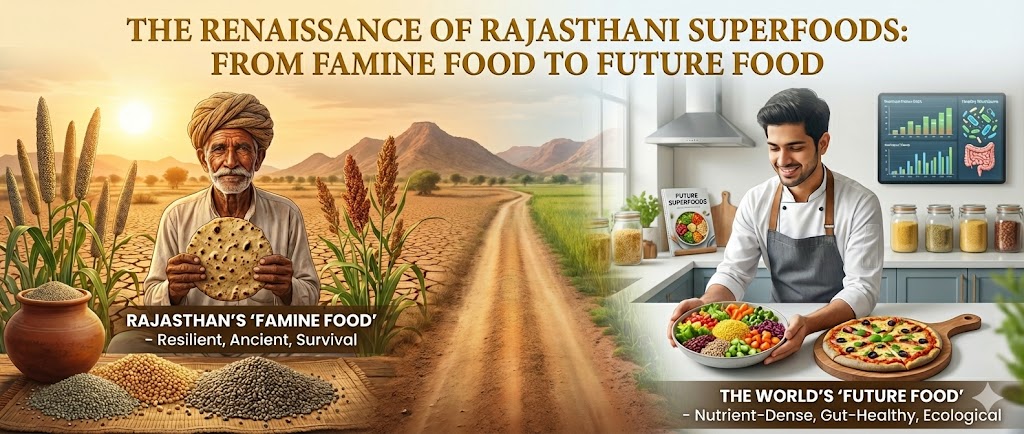
The Renaissance of Rajasthani Superfoods: From Famine Food to Future Food
The first time I saw a tourist grimace at a plate of Soghra, I laughed. They didn’t see the nutrient-dense, drought-defying miracle Millet on their plate; they just saw “coarse grain.” They saw poverty. I saw survival.
Standing in the Aravalli foothills, where the soil is thirsty and the sun is unforgiving, you realize that delicate crops like wheat and rice are merely visitors here. They are high-maintenance guests demanding water we simply don’t have. But Pearl Millet (Bajra) and Sorghum (Jowar)? They are the landlords. They own this land.
For decades, we’ve been told to “refine” our palate. We swapped stone-ground flour for bleached white dust. Now, as our water tables vanish and our gut health collapses, the world is finally listening to what our grandmothers whispered: Jaso Ann, Vaso Mann (As the food, so the mind).
This is not just a food trend. It is an ecological and biological necessity. This is the story of how Rajasthan’s “famine food” became the world’s “future food.”
The Water Logic: Why the Desert Rejects Rice
Why are we growing thirsty crops in a desert? It is a question of basic math that we have ignored for too long.
The 4000-Liter Mistake
Rice is a hydro-illogical crop for Rajasthan. To produce just one kilogram of rice, it takes approximately 4,000 liters of water. In contrast, Pearl Millet (Bajra) requires only about 1,200 liters, and in many traditional dryland farming systems, it survives on far less.
The “Shree Anna” Resilience:
Under the Prime Minister’s “Shree Anna” initiative (2023), the focus has shifted to “Nutri-Cereals” specifically because of this water efficiency.
- Rainfall Requirement: Rice panics if it receives less than 1200mm of rain. Bajra and Jowar thrive in 300-400mm.
- Heat Tolerance: As temperatures in Churu and Phalodi hit 50°C, wheat crops shrivel. Millets remain standing. They are C4 carbon-fixers, meaning they are biologically engineered to photosynthesize efficiently in high heat.
The Gut Microbiome: 2025 Science Meets Ancient Wisdom
We used to think fiber was just “roughage” to help you poop. We were wrong. The latest 2024-2025 research on the gut microbiome has completely redefined the role of coarse grains.
How Millets Feed Your “Good” Bacteria
Your gut bacteria, specifically strains like Ruminococcus and Bifidobacterium, cannot survive on processed wheat. They starve and die, leading to inflammation and “Leaky Gut.”
When you eat Finger Millet (Ragi) or Barnyard Millet, the insoluble fiber reaches your colon undigested. There, it undergoes saccharolytic fermentation.
- The Output: This process produces Short-Chain Fatty Acids (SCFAs) like Butyrate.
- The Benefit: Butyrate is the primary fuel for your colon cells. It repairs the gut lining, reduces systemic inflammation, and regulates the Gut-Brain Axis.
The Verdict: If you are feeling sluggish, anxious, or bloated, it might not be stress. It might be a lack of millet-derived prebiotics.
The Nutritional Comparison Matrix
Let’s look at the hard data. This matrix compares common staples against the “Big Three” Rajasthani millets.
| Nutrient (per 100g) | Wheat (Refined) | Rice (Polished) | Pearl Millet (Bajra) | Finger Millet (Ragi) | Sorghum (Jowar) |
| Calcium (mg) | 41 | 10 | 42 | 344 (Bone Health) | 25 |
| Iron (mg) | 3.9 | 0.7 | 8.0 (Energy) | 3.9 | 4.1 |
| Fiber (g) | 1.2 | 0.2 | 1.2 | 3.6 (Gut Health) | 1.6 |
| Glycemic Index | ~70 (High) | ~73 (High) | ~54 (Low) | ~60 (Med) | ~62 (Med) |
| Gluten | High | None | Zero | Zero | Zero |
1. Pearl Millet (Bajra): The Iron Horse
Best for: Anemia, Energy, Winter Warmth.
With 8mg of Iron, Bajra has nearly double the iron of wheat and ten times that of rice. In the bitter cold of a Rajasthani January, a Bajra Raab (fermented porridge) isn’t just food; it is internal heating.
(Deep Dive into The Bajra Guide)
2. Finger Millet (Ragi): The Calcium King
Best for: Bone Density, Kids, Seniors.
Ragi is a biological anomaly. No other grain comes close to its calcium content (344mg). For a vegetarian population, this is the primary defense against osteoporosis.
(Deep Dive into The Ragi Guide)
3. Sorghum (Jowar): The Gluten-Free All-Rounder
Best for: Celiac Disease, Weight Loss.
Jowar is the easiest swap for wheat lovers. It has a neutral flavor and makes soft rotis. It is rich in policosanols, which help regulate cholesterol levels.
(Deep Dive into The Jowar Guide)

Custodians of Heritage: The “Millets of Mewar” Story
In 2011, when Udaipur’s food scene was dominated by “Continental Breakfasts” and greasy curries, a small movement began near Lake Pichola.
“We Are What We Eat”
Millets of Mewar restaurant was built on a rebellious idea: that our “poor man’s food” was actually luxury.
They didn’t just serve traditional Soghra. They innovated.
- The Fusion Approach: They created Bajra Pizzas using a millet base instead of refined flour. They made Millet Aaloo Tikkis and Multigrain Cookies.
- The Philosophy: They proved that you don’t have to sacrifice taste for health. By bridging the gap between ancient crops and modern cravings, they saved these grains from extinction in the urban diet.
Quick Facts: Why Switch Now?
- 70% Water Savings: Millets use drastically less water than rice/wheat.
- Low Glycemic Load: Prevents the “sugar crash” associated with white bread.
- Pest Resistant: Their hard outer shell reduces the need for chemical pesticides.
- Alkaline Nature: Helps balance stomach acidity (good for GERD/Acid Reflux).
- Long Shelf Life: Millets can be stored for years, a crucial trait for famine security.
Conclusion: The Next Step in Your Diet
The “Renaissance” isn’t happening in a UN boardroom. It happens when you decide to buy a packet of Jowar flour instead of whole wheat. It happens when you choose a Bajra Roti over a Naan.
We have the data. We have the history. We know that these grains are better for the soil, better for the farmer, and better for your gut. The only question left is: are you ready to eat like your ancestors to save your future?