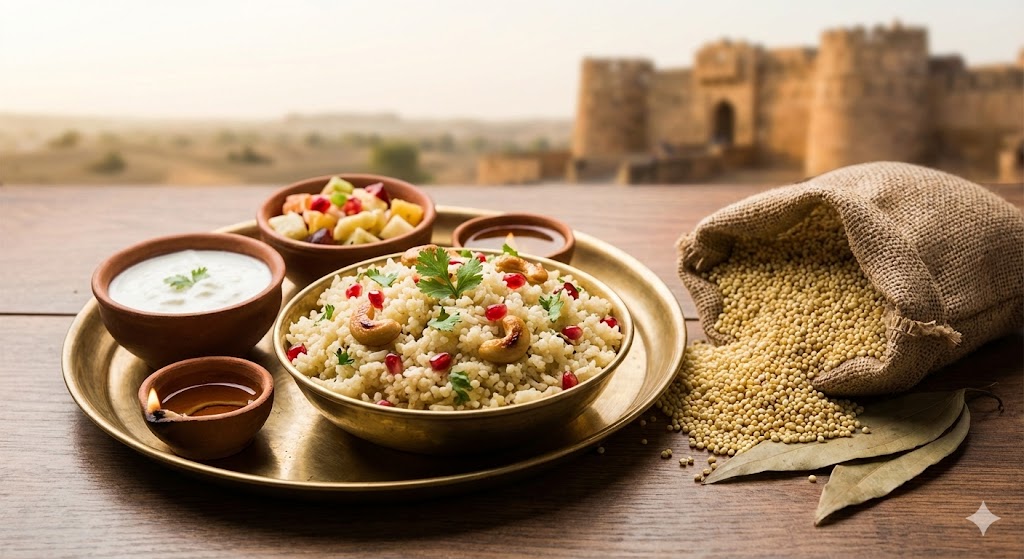
In Udaipur, you know Navratri has arrived not by the calendar, but by the smell of the kitchen. The usual aroma of wheat and onions vanishes. Instead, the air fills with the nutty, earthy scent of Sama roasting in ghee.
For nine days, we “starve” ourselves of cereal grains. Yet, we would serve a steaming bowl of Sama Khichdi (Barnyard Millet) that looked like rice, tasted like comfort, and kept us full until sunset. We called it Phalahar—fruit diet. I used to laugh, thinking, “This is clearly grain.”
I was wrong. Sama isn’t a grain. It is a grass seed, a pseudo-cereal that tricked the botanical definitions of “cereal” to find its way onto the holy plate. But more importantly, it is the biological weapon you need to survive a fast without crashing.
The “Vrat” Logic: Why We Eat Seeds, Not Grains
Why is wheat forbidden but Sama allowed during fasting? It’s not just ritual; it’s digestion.
Grain-free fasting is designed to give your digestive system a break from the heavy gluten of wheat. Sama (Barnyard Millet) fits the criteria because it is technically the seed of Echinochloa colona, a wild grass that grows aggressively in the Aravalli hills during the monsoons. It is “Wild Food,” unprocessed and untouched by modern hybridization.
Snippet Bait: Barnyard Millet (Sama) is allowed during fasting (Vrat) because it is botanically a seed (pseudo-cereal), not a true cereal grain like wheat or rice. Its high fiber and gluten-free nature make it a “light” food (Satvik) that digests easily while providing sustained energy during religious fasts.
The Glucose Trap: Why You Crash on Potatoes
Most people do fasting wrong. They replace wheat rotis with fried potatoes and Tapioca (Sabudana). This is a glycemic disaster.
The Low-Carb Miracle
Potatoes spike your blood sugar instantly. Sama stabilizes it.
- The Data: Barnyard Millet has the lowest carbohydrate content among all millets (around 65g/100g) and a high fiber content of 10.1%.
- The Result: When you eat Sama, the fiber creates a gel-like mesh in your stomach. This slows down the release of glucose into your bloodstream. You don’t get the “sugar crash” at 4 PM. You get steady, warrior-like focus.
2025 Science: The “Resistant Starch” Revelation
We used to think Sama was just “filler” food. New research from 2024-2025 on the Gut Microbiome proves it is actually a prebiotic powerhouse.
Feeding the Good Guys
A significant portion of the starch in Barnyard Millet is Resistant Starch (Type III). It resists digestion in the small intestine and travels straight to the colon.
- The Fermentation: There, it feeds beneficial bacteria like Bifidobacterium.
- The Benefit: This fermentation produces Butyrate, a fatty acid that heals the gut lining. If you feel lighter and cleaner after nine days of Navratri, it’s not just spiritual cleansing; it’s your microbiome celebrating the Sama diet.
The Chef’s Secret: Solving the “Mushy” Crisis
The biggest complaint I hear in my Udaipur kitchen is: “My Sama becomes a sticky paste.”
This happens because Sama cooks faster than instant noodles. If you blink, it turns to mush. The secret is in the Water-to-Grain Ratio.
Texture Control Guide
- For Fluffy Pulao (Biryani Style): Use a 1:2 ratio (1 cup Sama : 2 cups boiling water). Cook for exactly 6-7 minutes on low heat, then switch off the flame and let it sit covered for 10 minutes. The steam will fluff the grains.
- For Creamy Porridge (Kheer/Raab): Use a 1:4 ratio. Let the starch break down completely to create a silky, pudding-like texture.
Local Tip: In Mewar, we roast the dry grains in a little Ghee before boiling. This seals the outer layer and prevents the grains from clumping together.
Quick Facts: The Fasting Cheatsheet
- Scientific Name: Echinochloa frumentacea.
- Fiber Content: ~10.1% (Highest among fasting foods).
- Iron: ~15.2 mg/100g (Excellent for fatigue).
- Calories: Lowest caloric density among millets (great for weight loss).
- Cook Time: Very fast (under 10 minutes).
- Taste Profile: Mild, nutty, absorbs flavors easily (like a sponge).
Conclusion: Don’t Wait for Navratri
We have relegated this supergrain to the “religious corner” of our pantry. That is a mistake.
Why wait for October to fix your blood sugar? Why wait for a fast to feed your gut bacteria? Sama is cheap, it grows locally in our Rajasthan soil with barely any water, and it cooks faster than white rice.
Next time you want a light dinner, skip the heavy wheat roti. Make a Sama Pulao with seasonal vegetables. Your gut doesn’t know the religious calendar—it only knows good nutrition.