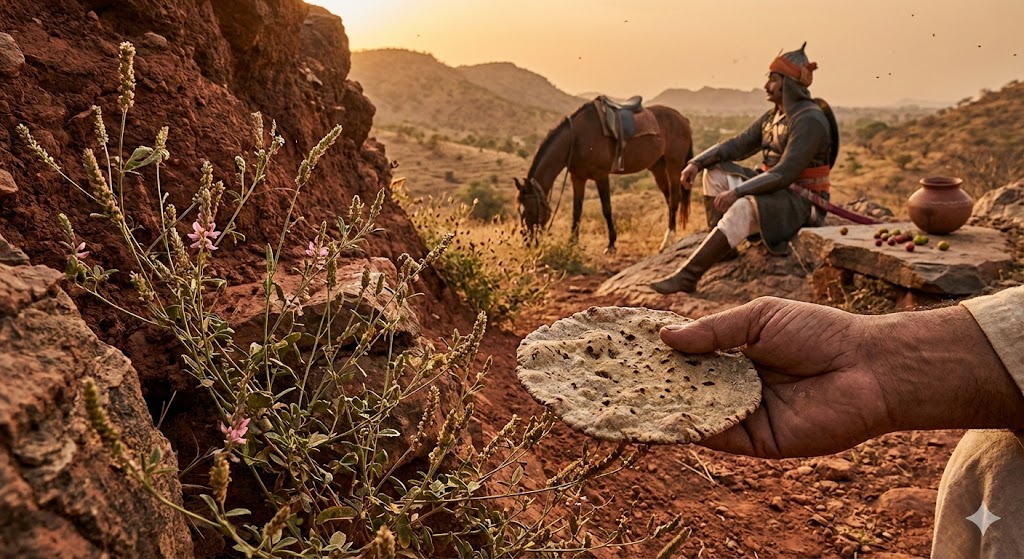
You can still taste the dust in the air at Haldighati. It’s a red, iron-heavy dust that coats your throat and reminds you that this land is not soft. When I walk these hills, looking for wild herbs, I often think about the stories we tell our children. The most famous one is tragic: a King, reduced to poverty, weeping because a wild cat stole his “grass roti” (Ghas ki Roti).
It makes for good poetry. But as a nutritionist and anthropologist, I am telling you: it is bad history.
Maharana Pratap didn’t eat grass because he was poor. He ate wild grains because he was smart.
The Myth of the “Grass” Roti
We need to clear the air. The “grass” mentioned in the famous poem by Kanhaiyalal Sethiya was not lawn grass. Humans cannot digest cellulose-heavy lawn grass; we are not cows. If Pratap’s army had eaten actual grass, they would have died of malnutrition in weeks.
So, what was it?
The “grass” was actually wild, uncultivated millets and protein-rich legumes that grow spontaneously in the Aravalli rock crevices. These are not weeds; they are ancestors.
The Botanical Reality
The “rotis” were likely made from the seeds of Echinochloa colona (Wild Barnyard Millet or Sama) and Indigofera linifolia (locally known as Gari or Torki).
Snippet Bait: Maharana Pratap’s “grass rotis” were actually made from Indigofera linifolia (Gari) and wild millet seeds (Sama). These native plants are drought-resistant, high-protein superfoods that provided dense nutrition for prolonged guerrilla warfare, not signs of desperate poverty.
Survival Botany: The Fuel of Guerrilla Warfare
When you are fighting an army ten times your size, you cannot rely on slow-growing wheat convoys. You need food that grows itself. Pratap’s strategy wasn’t just military; it was botanical.
The “Gari” Advantage (Indigofera linifolia)
Indigofera is a wild legume often found in the dry rocky soils of Mewar.
- The Protein punch: While wheat has about 12% protein, Indigofera seeds can contain up to 30% protein.
- The Logic: For a soldier carrying 20kg of armor and climbing vertical hills, protein is the primary fuel for muscle repair. A Gari roti is essentially a medieval protein bar.
“Sama” (Jungle Rice)
Echinochloa colona, or Jungle Rice, grows rapidly after the first rains. It matures in 45-60 days (wheat takes 120).
- Glycemic Index: It releases energy slowly. Wheat gives you a sugar spike and a crash. Sama gives you sustained endurance—exactly what you need for an ambush.
Your Gut Craves the Warrior’s Diet
Modern science is just catching up to Rajput wisdom. In 2024, microbiome researchers are finding that our guts are losing the ability to process complex wild fibers.
The “Rewilding” of the Gut
We have sanitized our diets. We eat soft, processed grains. Pratap’s army ate “rough” grains rich in resistant starch.
- The Microbiome Connection: Wild grains feed Bifidobacteria in the colon. This produces short-chain fatty acids that lower systemic inflammation.
- The Mental Edge: The gut-brain axis is real. A healthy, diverse microbiome (fed by diverse wild grains) leads to better stress resilience. Pratap’s mental fortitude in the forest might have been biologically supported by his gut health.
Nutritional Comparison: Court Food vs. Forest Food
Let’s compare what the Mughals were likely eating (refined wheat/meat) vs. what the Rajputs were eating (Wild Millets/Legumes).
| Nutrient | Refined Wheat (Court Diet) | Wild Indigofera/Millet (Forest Diet) |
| Protein | ~10-12% | 25-30% (Indigofera) |
| Fiber | Low | High (Prebiotic) |
| Minerals | Moderate | Dense (Zinc/Iron rich soils) |
| Water Needed | High | Zero (Rainfed) |
The Mughals had calories. The Rajputs had density.
Quick Facts: The Aravalli Pantry
- Torki/Gari: Wild legume seeds, ground into flour. High protein.
- Sama (Barnyard Millet): Fast-growing, high fiber, gluten-free.
- Matera (Wild Watermelon Seeds): Rich in healthy fats and magnesium.
- Kair-Sangri: Dried berries and beans, Vitamin C rich, kept the army scurvy-free.
- Sustainability: These crops require zero irrigation, crucial for a besieged army cut off from water sources.
Conclusion
We look back at history and see pity where we should see power. Maharana Pratap’s diet was not a compromise. It was an adaptation. He utilized the indigenous botanical intelligence of the Aravalis to fuel a resistance that the mighty Mughal empire could not break.
You don’t need to go to the forest to eat like a warrior. Next time you see Sama rice (Barnyard millet) in the store during fasting season, don’t just see it as “religious food.” See it as “resistance food.” Buy it. Cook it in a clay pot. Feed your gut the wildness it is starving for.