Foxtail Millet (Kangni): The Beauty and Brain Grain
Walk through any village in the Aravalli hills a few decades ago, and you would hear a distinct rhythm echoing off the stone walls. Thud. Thud. It wasn’t the sound of a single kitchen; it was the heartbeat of the harvest season. In the shared courtyards of Mewar, families weren’t just processing grain; they were preparing their “recovery food.” They were dehulling Kangni (Foxtail Millet).
The local consensus was simple but specific. If a farmer took a bad fall on the rocky slopes, or a young scholar needed to memorize their lessons, the community didn’t offer them wheat or rice. They offered Kangni.
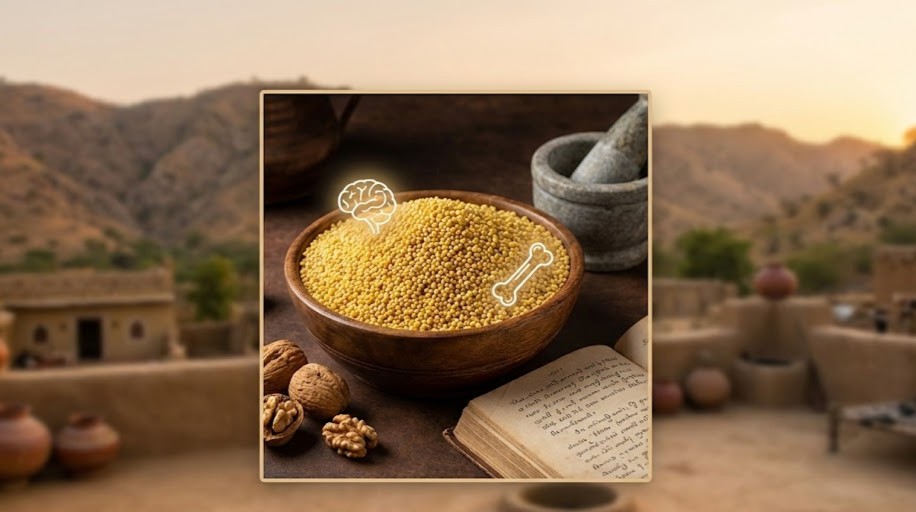
They didn’t have access to nutritional labels, nor did they know about neurotransmitters or amino acid profiles. What they had was centuries of observational data. They noticed, generation after generation, that this tiny yellow grain helped broken bones knit faster and kept the mind sharp during long days of labor. “This is what you eat to stand tall,” the elders would say.
Somewhere along the way, we traded this collective intelligence for the convenience of polished white rice and the promise of expensive supplements. We swapped a proven staple for empty calories. It is time to trade back.
The Brain Food: Wiring Your Nervous System
We are facing an epidemic of “brain fog.” We forget names. We lose focus. We are tired.
The Thiamine Connection
Foxtail Millet (Kangni) is a neurological powerhouse because it is exceptionally rich in Vitamin B1 (Thiamine), the critical nutrient required for the production of acetylcholine, a neurotransmitter that transfers messages between nerves and muscles.
Snippet Bait: Foxtail Millet (Kangni) is called the “Brain Grain” because it is rich in Vitamin B1 (Thiamine) and Iron, which support the nervous system and cognitive function. Its high protein content (12.3g) helps synthesize neurotransmitters, fighting brain fog and improving memory recall better than refined cereals.
While the internet buzzes about B12 (mostly found in animal products), we often ignore B1. Without B1, your brain cannot turn glucose into energy. You feel sluggish. Eating Foxtail Millet is like plugging your brain directly into a charger.
Ayurveda’s “Kangu”: The Fracture Healer
In the ancient texts of Ayurveda, Foxtail Millet is known as Kangu. It isn’t just a calorie source; it is medicine.
Bhagna Sandhana (Knitting the Broken)
Ayurveda prescribes Kangu specifically for Bhagna Sandhana, or the healing of fractures.
- The Protein Scaffold: Bones are not just calcium; they are a matrix of collagen protein. Foxtail Millet delivers 12.3g of protein per 100g. This is the raw material your body needs to rebuild tissue.
- The Iron Factor: With high iron content, it ensures that oxygen-rich blood reaches the site of the injury, accelerating repair.
Local Insight: In the tribal belts of Mewar, when an elder suffers a fall, the community doesn’t just bring milk. They bring Kangni ki Kheer. They know it knits bones faster than any calcium tablet.
A Culinary Chameleon: The Rice Replacement
The biggest lie we tell ourselves is that healthy food tastes bad. Foxtail Millet proves us wrong.
The Sweet, Nutty Surprise
Unlike the earthy Bajra or the slightly bitter Ragi, Foxtail Millet is sweet. It has a delicate, nutty flavor that mimics the texture of Arborio rice or Couscous.
How to Eat It:
- The Pulao Switch: Do not change your recipe. Just swap the Basmati. Foxtail grains stay separate and fluffy, absorbing the spices of cardamom and clove beautifully.
- Bisibelebath: The grain releases just enough starch to make a creamy, comforting Bisibelebath or Khichdi without turning into glue.
Chef’s Note: Always soak Foxtail Millet for at least 6-8 hours. This removes phytic acid and ensures the grain cooks evenly. If you skip this, you miss the nutrients.
Quick Facts: The Kangni Advantage
- Scientific Name: Setaria italica.
- Protein: ~12.3g (High plant-based protein).
- Ayurvedic Action: Brumhana (Nourishing/Building).
- Taste: Madhura (Sweet).
- Best For: Growing children, pregnant women, and the elderly.
- Skin Health: Rich in amino acids that support collagen production (The “Beauty” aspect).
Conclusion: Eat for Your Future Self
We spend thousands on skin creams and brain-training apps. Yet, we ignore the yellow grain that does both for the price of a movie ticket.
Foxtail Millet is not just a dinner option. It is an investment in your neurology and your skeleton.
Next time you are at the market, walk past the polished white rice. Find the bag of Kangni. Take it home. Make a simple Pulao. Your brain will feel the difference before your stomach is even full.
Would you like me to share a “Kangni & Moong Dal Khichdi” recipe specifically designed for easy digestion and recovery?